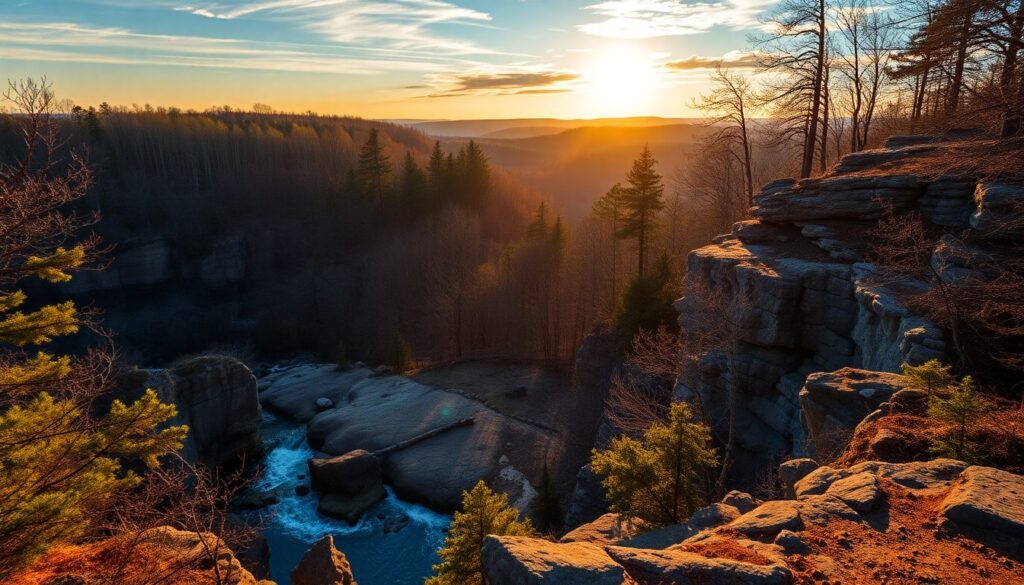
Stepping onto the Soldiers Delight Serpentine trail, you are immediately transported to a landscape unlike any other in Maryland, where the very earth underfoot tells a story of ancient geology and resilient life. The signature serpentine rock, a greenish-grey stone rich in magnesium and iron, creates an open, almost treeless barren, where sunlight drenches the sparse, unique vegetation. Here, the air carries the scent of sun-baked earth and hardy grasses, a stark contrast to the lush deciduous forests typically found in the region, offering an unparalleled opportunity to witness a rare ecosystem thriving against all odds.
Trail Specifications
Trail Name: Soldiers Delight Serpentine Trail Loop
Location: Owings Mills, MD (Soldiers Delight Natural Environmental Area)
Distance: Approximately 3.5 miles (main loop)
Elevation Gain: Approximately 250 feet
Difficulty: Moderate (due to rocky terrain and sun exposure)
GPS Coordinates (Trailhead): 39.4034° N, 76.8407° W
Best Season: Spring and Fall for wildflowers and comfortable temperatures
Dog-Friendly: Yes, on leash only
Route Overview & Natural Highlights
Your journey across the Soldiers Delight Serpentine barrens is a lesson in ecological resilience. The terrain is characterized by its unique geology: the underlying serpentine rock creates a soil high in heavy metals like nickel and chromium, and low in essential nutrients like calcium. This harsh environment acts as a natural filter, allowing only specialized, “serpentinophile” plants to thrive. You’ll traverse a mix of exposed, rocky paths and sections that skirt the edges of surrounding oak-hickory woodlands, offering a dynamic hiking experience.
As you hike, keep an eye out for the distinctive dwarf post oak (Quercus stellata var. pumila), a stunted form of its forest cousin, and the delicate serpentine aster (Symphyotrichum depauperatum), found almost exclusively in these rare habitats. Lichens and mosses cling to the exposed rock, creating intricate patterns, while various grasses and sedges form a sparse groundcover. This area is also historically significant; it was the site of the first commercial chromite mine in the United States, active in the early 19th century. Beyond the unique flora, the open landscape provides excellent opportunities for birdwatching, with species adapted to open country, and you might spot various reptiles and insects drawn to the sun-drenched rocks.
Turn-by-Turn Trail Breakdown
Trailhead start
Begin your adventure from the main parking lot near the visitor center. The trail is well-marked with orange blazes. You’ll start on a wide, relatively flat path that quickly opens up into the characteristic serpentine barren. Observe the immediate change in vegetation as you leave the surrounding forest edge, with trees becoming sparser and more stunted. The path here is generally firm but can be uneven with exposed rock fragments.
Mid-trail features
As you delve deeper, the trail will undulate gently, revealing expansive views across the barren landscape. You’ll encounter several interpretive signs explaining the unique geology and ecology of Soldiers Delight. The path becomes rockier in sections, requiring careful footing. Keep an eye out for the distinct greenish hue of the serpentine rock. You’ll pass through areas where the path is almost entirely exposed bedrock, a testament to the harsh conditions. This middle section offers the most immersive experience of the serpentine ecosystem, with its unique plant communities.
Summit/destination & return
The trail doesn’t have a distinct “summit” in the traditional sense, but rather a continuous loop that brings you through the most scenic sections. The furthest points of the loop offer the best panoramic views of the barrens, particularly rewarding on clear days. As you complete the loop, the trail will gradually lead you back towards the visitor center, transitioning from the open barrens back to the more familiar surrounding woodlands. The return path offers a chance to reflect on the rare beauty you’ve witnessed, often with new perspectives on the flora and fauna you might have missed on the way out.
Seasonal Guide & Best Times
- Spring (March – May): This is arguably the prime season. Milder temperatures make for comfortable hiking, and the unique wildflowers of the serpentine barrens burst into bloom, including the delicate serpentine aster and various sedges. New growth brings a subtle green to the landscape.
- Summer (June – August): Expect significant sun exposure and heat. While some unique summer blooms can be found, this season is best for early morning or late afternoon hikes to avoid the midday sun. Be prepared for insects and bring plenty of water.
- Autumn (September – November): Cooler temperatures return, offering excellent hiking conditions. While the serpentine barrens themselves don’t display dramatic fall foliage, the surrounding oak-hickory woodlands provide a beautiful backdrop of reds, oranges, and yellows. The clear air often provides expansive views.
- Winter (December – February): The landscape takes on a stark, minimalist beauty. With leaves off the trees, views are even more expansive. While cold, a clear winter day can offer a peaceful and solitary hiking experience. Watch for icy patches, especially after precipitation.
Essential Gear & Safety
- Sturdy hiking boots or shoes with good ankle support are recommended for the rocky, uneven terrain.
- Carry ample water, especially during warmer months, as the trail offers little shade.
- Sun protection is crucial: a hat, sunglasses, and sunscreen will shield you from the exposed sun.
- A map or GPS device is helpful for navigation, though the trail is generally well-marked. You can find a detailed map on AllTrails.
- A basic first-aid kit is always a smart addition for minor scrapes or blisters.
Getting There & Parking
Soldiers Delight Natural Environmental Area is located in Owings Mills, Maryland, easily accessible from the Baltimore metropolitan area. From I-795, take Exit 4 towards Owings Mills Boulevard, then follow local signs to the park entrance. The main parking lot is situated near the visitor center at 5100 Deer Park Road, Owings Mills, MD 21117. Parking is free and typically ample, but it can fill up on peak weekend afternoons. The park gates generally open at sunrise and close at sunset; always check current operating hours on the official Maryland Department of Natural Resources website before your visit. The preserve is a short drive from other regional attractions like Patapsco Valley State Park, making it an excellent stop on a day of exploring Maryland’s natural beauty.
Curated Literature & Baltimore Downtown Calendar
The Architecture of Focus: Deep Work & Modern Mastery
By Founders Library Press
A structured framework for strategic clarity, productivity, and authentic execution.
Upcoming Downtown Happenings
Live acoustic sessions, gallery receptions, literary salons, and independent trade shows across Baltimore.